
SLA in commercial customer service: what to measure and enforce
Learn which SLA metrics actually matter in commercial customer service and how to track deadlines in real time without micromanaging your team.
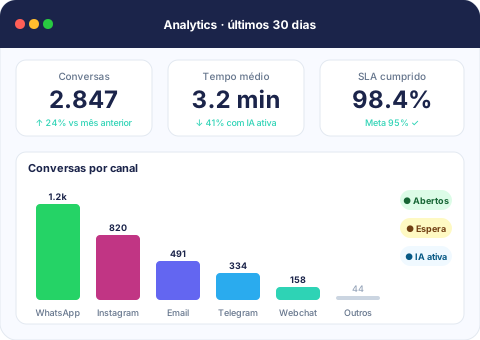
An SLA that lives only in the manager’s head protects no one. The team promises “reply within 1 hour” or “resolution same day,” but without real-time visibility into who’s about to miss the deadline, the delay only surfaces once the customer is already annoyed — or worse, once they’ve already decided to go with a competitor. Setting an SLA is easy. Tracking it in a way that actually changes behavior is usually what’s missing.
SLA is not just first-response time
It’s common to reduce SLA to a single metric: how long until someone replies to the message. That matters, but it’s only the starting point. A healthy commercial service operation looks at least at three different moments in the cycle:
- Time to first human reply (or to a useful AI response, when that applies)
- Time until the conversation actually moves forward — proposal sent, question resolved, meeting booked
- Time until the ticket closes, with the issue or negotiation genuinely wrapped up
Measuring only the first point creates a well-known side effect: the team replies fast with a generic “I’ll get back to you” just to hit the target, while the customer keeps waiting for the answer that matters. An SLA without that distinction measures reaction speed, not resolution speed — and it’s resolution speed that decides whether the deal closes.
What to actually measure
Before holding anyone on the team accountable to a deadline, it’s worth mapping the numbers that genuinely indicate the health of the operation:
- SLA compliance rate by channel — WhatsApp, email, and webchat tend to carry different speed expectations; applying the same deadline to all of them usually creates an unfair standard on at least one channel
- SLA compliance rate by rep — not to punish individuals, but to spot whether the bottleneck is uneven queue distribution rather than performance
- Average resolution time by conversation type — a simple question and a complex negotiation shouldn’t compete for the same deadline
- Volume of tickets with no assigned owner — SLAs often break not because someone was slow, but because the conversation had no owner in the first place
An SLA only becomes real management when the delay shows up before the ticket breaks, not after. Enforcing a deadline with next month’s report is auditing; tracking it in real time is management.
How to track it without turning into micromanagement
The risk of taking SLA seriously is turning the operation into constant surveillance, with a manager checking in on every rep hour by hour. That wears the team down without fixing the root cause of the delay. The more sustainable path combines three things: commercial tickets with SLA tracked in real time, a queue organized with clear owners, tags, and status, and reports on volume, conversion, SLA, and quality that show patterns, not just exceptions.
With that in place, the manager doesn’t need to ask “how’s this ticket doing?” one by one — the dashboard already shows which conversations are close to their deadline, which ones already missed it, and which channel it’s concentrated in. Enforcement turns into a conversation about what’s happening in the queue, not a manual check of every conversation in /sales.
Where SLA intersects with the rest of the operation
SLA doesn’t exist in isolation from lead qualification, an organized queue, or CRM context. A poorly qualified contact that lands as high priority distorts the deadline metric, because it eats up resolution time that should go to someone who genuinely needs a fast answer. Likewise, a conversation history scattered across different channels slows down resolution, because whoever picks up the conversation loses time rebuilding context before they can even reply.
That’s why measuring SLA in isolation, without looking at how the queue is organized and what context is available in the conversation CRM, tends to produce the wrong diagnosis: it looks like the team is slow, when what’s actually missing is structure before the clock even starts.
Where to start
Before setting SLA targets for the team, it’s worth running two weeks of pure observation: which channel misses deadlines most often, whether delays concentrate on a few reps or are spread out, and whether unassigned tickets make up a meaningful share of the total. That diagnosis avoids arbitrary targets — like “every reply in 15 minutes” — that ignore the operation’s real volume and complexity.
If your team still tracks service deadlines with a manual spreadsheet or by asking around one conversation at a time, see how TheChats.me plans organize tickets with real-time SLA tracking and schedule a demo to see the dashboard working with your queue’s real volume.