
Omnichannel vs multichannel: the difference that stalls growth
Why having several support channels isn't the same as being omnichannel, and how that gap quietly costs you leads and conversions.
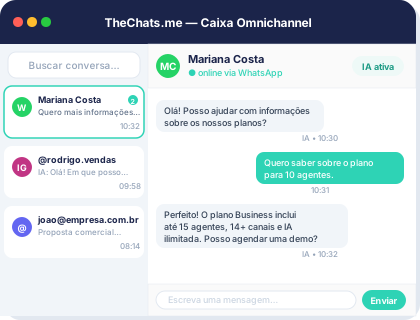
Every company that talks to customers today is already on several channels: WhatsApp, Instagram, email, webchat. That makes it multichannel — but not necessarily omnichannel. The distinction sounds cosmetic until the day a lead messages on Instagram, goes quiet, then comes back on WhatsApp asking “so, did anyone see my message?” and whoever answers has no idea what they’re talking about.
Multichannel means having channels. Omnichannel means having context
Multichannel means the company shows up in several places — each channel with its own inbox, often in entirely different tools. One rep handles WhatsApp, another Instagram, a third answers email. It works fine until volume grows, or until a customer switches channels mid-conversation.
Omnichannel is when those channels converge into a single history per contact, regardless of where the message came in. If a lead wrote on Instagram yesterday and sends a WhatsApp message today, whoever replies sees the full conversation, not a blank slate. That difference isn’t cosmetic — it’s what decides whether the business keeps commercial context every time a customer switches channels, or loses it.
Where the multichannel queue stalls growth
The most common symptom of a multichannel setup without unification is a fragmented queue: one rep watching WhatsApp, another Instagram, another email, with no view of total volume or who’s overloaded. As the operation grows, this model doesn’t scale — every new channel (Telegram, SMS, a marketplace) becomes one more screen to check, one more place where a lead can get forgotten.
That has a direct cost on conversion. A lead who messages and doesn’t get a fast reply because nobody happened to be watching that specific channel at that moment is a lead already talking to another vendor. The problem compounds when the same contact shows up on two channels as if they were two different people — the team loses history and re-asks questions the customer already answered.
Multichannel asks “how many places are we present in?” Omnichannel asks “when a customer switches channels, do we recognize it’s the same person?” The second question is the one that decides whether support builds trust or frustration.
What changes with a unified inbox
A real omnichannel inbox brings WhatsApp through the official API, Instagram, Facebook, Telegram, email, webchat, and marketplace channels like Vinted, eBay, Etsy, and Amazon into a single queue, organized by owner, tag, and status. That solves two problems at once: it gives whoever manages the operation visibility into total volume, and it guarantees each contact has one history, not one per channel.
In practice, this also changes how AI operates inside support. Automatic triage and lead qualification work on the contact’s full history, not on an isolated fragment from one channel — which avoids repeating already-answered questions and improves the quality of the handoff to whoever closes the deal or resolves the case. Reply suggestions and conversation summaries also get more useful when they have the full context available, not just the last message received on that particular channel.
Signs your operation is still multichannel, not omnichannel
Some signs are easy to spot in day-to-day work:
- Reps switch between different tabs or apps to cover every channel
- The same customer shows up as a “new” contact when they switch channels
- There’s no single view of volume, SLA, or queue across channels
- Support reports are built channel by channel, with no consolidation
- The team can’t say, without digging, the full history of a given contact
If two or more of these sound familiar, the operation has probably already paid the price of fragmentation in a lost lead or a frustrated customer repeating the same information twice.
Consolidating without losing what already works
Moving to omnichannel doesn’t require abandoning the channels that already deliver results — it requires unifying them in a single workspace. That applies to sales operations as much as to teams selling on marketplaces, where centralizing Vinted, eBay, Etsy, and Amazon in the same inbox stops orders and questions from getting lost between platforms.
Segments with more specific service flows — like real estate teams juggling portal leads and WhatsApp at the same time, or clinics scheduling across several channels — feel this gain even more directly, because volume per contact tends to be higher and the cost of losing context is steeper.
If your team is still running one screen per channel, it’s worth seeing how the omnichannel inbox works in practice, and booking a demo to watch the unified queue handle a case similar to yours.