
Intercom alternative for SMBs: what to evaluate
What to check before switching from Intercom: channels, AI, per-seat pricing, GDPR tooling, and how to decide without spending months on migration.
Plenty of small and mid-size teams start with a support tool built for tech companies operating at global scale, and a few months in they notice they’re paying for features they don’t use while missing the ones they need most. The most common symptom: the invoice grows faster than the team does. Every new agent, every AI feature, every extra channel becomes one more line item — and support still isn’t the center of the commercial operation.
Before deciding to switch platforms, it helps to separate a one-off frustration from a structural mismatch between the tool and the kind of operation an SMB actually runs day to day.
Why the search for an alternative usually starts
Three reasons come up most often when small and mid-size teams start evaluating a switch:
- Pricing that scales with seats and features, not with value delivered to the operation — small teams end up paying for plans built for large support squads.
- AI as a paid add-on, instead of being part of the workflow from the base plan.
- The highest-volume channel treated as secondary: for operations with a strong WhatsApp presence, a tool built primarily for web chat and email leaves that channel as an afterthought.
None of this makes the tool itself bad — it’s a mismatch between who it was built for and the kind of team trying to use it.
What to evaluate before switching
Switching platforms has real costs: migration, retraining, and process changes. It’s only worth it when the new tool fixes something structural, not just a one-off complaint. Useful questions to put every option side by side:
- Is WhatsApp a first-class channel or a plugin? In markets where WhatsApp carries most of the commercial volume, this changes the day-to-day experience for both agents and customers.
- Does AI already sit inside triage and qualification, or is it a separate module? Reply suggestions, conversation summaries, and automatic lead qualification before handoff belong in the core workflow — not as an isolated upsell.
- Does pricing scale predictably? Plans with clearly defined seats, conversations, and AI tickets per tier make it easier to budget for growth without renewal surprises.
- Is there a no-card entry point? Testing the tool against a real operation before committing budget lowers the risk of switching.
- Is GDPR compliance built into the product or handled manually by the team? Per-contact data export, automated deletion, and an audit dashboard keep compliance from becoming a parallel task.
Switching customer service tools shouldn’t be a six-month project. If the decision needs a committee and a risk spreadsheet, the problem might not be which platform to pick — it might be that none of the options evaluated were built for the size of your team.
Where the difference shows up in practice
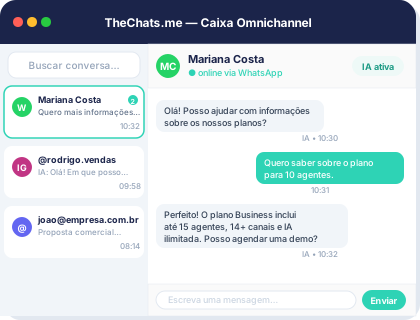
In TheChats.me, the unified inbox ships with WhatsApp through the official API, Instagram, Facebook, Telegram, email, and webchat in one place, with a single queue organized by owner, tag, and status — no extra integration needed for the channel that drives the most commercial conversation. AI-driven triage, lead qualification, reply suggestions, and conversation summaries sit inside the workflow from day one, with an AI audit trail for teams that need to explain automated decisions. Teams that already have their own AI key can use BYOK instead of paying for the same model cost twice.
Sign-up starts on the Free plan, with 2 agents and 1 channel, no credit card required — enough to test the real support flow before committing to a full migration. From there, paid plans scale by seat, conversation volume, and AI-handled tickets, with custom plans available directly on the platform as the operation grows.
GDPR without extra manual work
One factor that often weighs heavily in the evaluation, especially for operations serving European customers, is how much manual work a platform requires to stay compliant. Per-contact data export, automated deletion, and an audit dashboard for DPOs are part of TheChats.me’s core structure — including in the webchat, with a built-in consent banner in the widget, no separate tool needed for that part of the flow.
If your team is evaluating a switch, it’s worth comparing point by point using the criteria above instead of deciding purely from a feature list on a competitor’s site. See the full comparison on the Intercom alternative page, or schedule a demo to test the omnichannel inbox against a real case from your operation.