
Every sales rep has spent twenty minutes on a conversation that ended with “actually, I just wanted to know the price” — from someone who never had real buying intent. Multiply that by the volume of messages coming in through WhatsApp, Instagram, and webchat every day, and it’s clear why qualifying leads manually, one by one, is the bottleneck that stalls the sales queue before it even starts.
The cost of qualifying everything by hand
When every incoming message gets the same treatment — a human reads it, decides if it’s worth pursuing, collects the basic details, and only then decides whether to hand it off — the rep’s time becomes the ceiling on the whole operation. On busy days, that means good leads waiting in line behind contacts who were never going to close, or worse: a rep burning energy on a generic question while a qualified lead gives up waiting on another channel.
This isn’t a lack of effort from the team. It’s that manual triage scales badly: doubling conversation volume means doubling the time spent filtering, not doubling sales.
Where automatic triage comes in
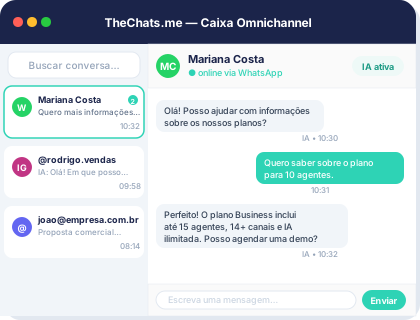
Automatic qualification acts before the human handoff, evaluating the conversation the moment it arrives. Instead of waiting for a rep to decide whether a contact deserves attention, the AI runs an initial triage first: it identifies whether the message carries real commercial intent, collects basic contact data during the conversation itself (name, need, context), and organizes it before anyone on the team has to step in.
This doesn’t replace a rep’s judgment on negotiation, pricing, or closing — that’s still human work. What automatic triage solves is the filter that comes before it: making sure that when a rep joins the conversation, they already know who the contact is and what they want, instead of starting from zero by asking the obvious.
Qualifying isn’t about deciding whether a lead will buy — it’s about deciding whether it’s worth a human’s time right now. Automating that second question is what frees up the first one for the people who actually know how to answer it.
How this works inside the sales queue
With every channel organized in a single inbox, automatic triage operates on any incoming message — WhatsApp, Instagram, email, or webchat. The typical flow follows this logic:
- The conversation arrives and the AI asks context questions when needed, without waiting for a human to be available
- Collected data (name, interest, urgency) gets attached to the contact, visible to whoever picks up the conversation
- Contacts outside the sales profile — a one-off question, support request, spam — get handled without consuming a rep’s time
- Qualified leads get handed off with tags and status already set, ready to enter the right queue
This process depends on the queue being organized with clear owners, tags, and status — without that, even a well-qualified lead can get lost between channels. It’s the same reason the difference between having several channels and actually unifying them matters so much for conversion.
What changes for the rep
In practice, the rep stops opening every conversation blind. They receive the contact with context already attached: what the person asked, what the AI already answered, and whether that lead fits the profile the company is looking for. That cuts the time to a useful first reply and avoids repeating questions the customer already answered to the automated assistant.
Sales teams working through /sales and teams building commercial pipelines for SaaS, clinics, or real estate face this same problem at different intensities: the higher the volume of unqualified messages, the more time automatic triage saves — and the faster a real lead gets human attention.
It’s worth noting that automatic qualification isn’t about removing the human from the conversation — it’s about not wasting their time on questions a well-configured AI already resolves before the handoff even happens.
Where to start
Before automating qualification, it’s worth mapping what actually eats up the team’s time today: repetitive questions, off-profile contacts, or lack of context at handoff. That answer helps decide where automatic triage will produce the fastest gain — whether by cutting irrelevant volume or by speeding up the decision on contacts already qualified.
If your sales operation still depends on a rep reading every message to decide whether it’s worth continuing, see how automatic triage and qualification works inside TheChats.me and schedule a demo to see the flow running with your queue’s real volume.